Loofy AI
In progressMeeting-bot SaaS — Google Meet today, Zoom and Teams next. Live transcription, speaker ID, bidirectional audio, and API-driven post-meeting workflows.
Founder / full-stack engineer
loofy-ai_case_study.sh
// Problem
Teams don't run every meeting on one platform. They need more than a recording script: a bot that joins calls on Google Meet (and soon Zoom, Teams, and others), captures meeting context in real time, and exposes that data through a reliable API and UI for notes, action items, and downstream automation.
// What I built
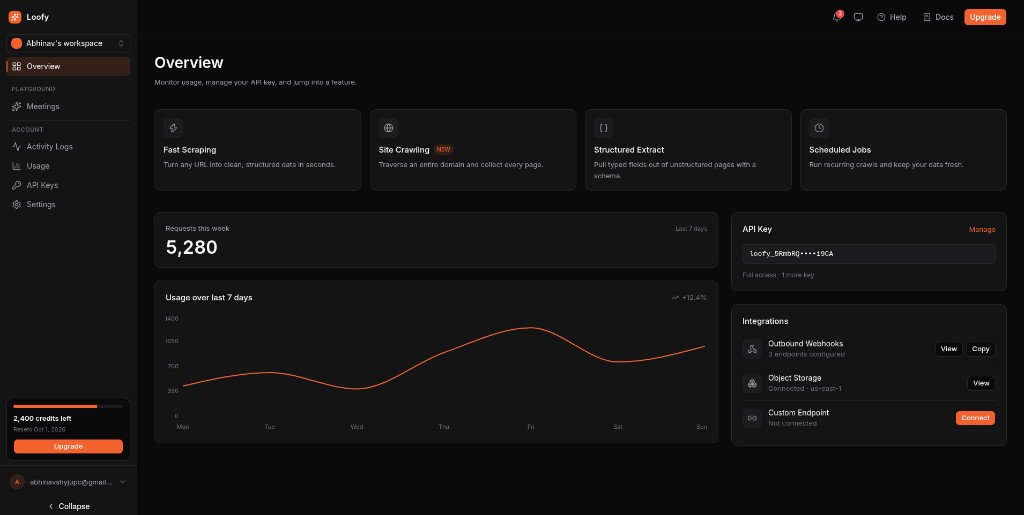
I built Loofy AI as a SaaS platform around a meeting bot, starting with Google Meet and planning support for Zoom, Microsoft Teams, and other providers. The bot joins meetings and captures audio with live transcription and speaker identification. API endpoints and a dashboard let teams post-process meetings — generating notes, action items, and other artifacts. Loofy also supports bidirectional audio over WebSocket (mic in, speaker out), backed by a multi-model AI engine (LLMs, STT, TTS) that can listen to the conversation and respond in-meeting. Compared to competitors, the Loofy API is significantly cheaper and more reliable, with a broader feature set (AI bot usage billed separately).
// Architecture
Monorepo with three surfaces: bot/ (meeting joiner, orchestration, FastAPI + PostgreSQL), saas/ (Vite + React dashboard and Astro Starlight API docs), and app/ (prototype frontend). The bot pipeline uses a provider join layer — Google Meet shipped first, with Zoom and Teams adapters planned — then handles real-time audio capture, transcription, and speaker diarization. REST and WebSocket endpoints expose capture data and bidirectional audio streams. Post-meeting workflows run against stored transcripts and metadata. Docker packages services for deployment.
// Stack
// Outcomes
- ▸ Google Meet bot joins calls and captures audio, live transcription, and speaker identification
- ▸ API + dashboard for post-meeting workflows (notes, actions, and more)
- ▸ Bidirectional WebSocket audio streaming for in-meeting AI voice
- ▸ Multi-model orchestration (LLMs, STT, TTS) for conversational AI that listens and responds
- ▸ SaaS API that is cheaper and more feature-rich than alternatives (excluding AI bot compute)
- ▸ Roadmap to extend beyond Google Meet to Zoom, Microsoft Teams, and other meeting platforms
- ▸ Structured monorepo separating bot core, SaaS dashboard, and docs